SCIENCE! Shows Notebooks are Best for ADHD Brains
The TL;DR for those who are not quite as brain nerdy is that between taking notes by typing, writing notes on a tablet, or making notes in a physical notebook, the most brain activity (related to comprehension and retention) came from good old dead-tree-and-ink.
SCIENCE! Shows Notebooks are Best for ADHD Brains
Except for Inatttentive Type. Maybe.
NEWS FLASH FROM THE UNIVERSITY OF TOKYO! GODZILLA HAS BEEN SIGHTED —
Hang on, my editor is waving frantically at me…Ah. No. Not Godzilla. Not a news flash, either, as this news came back in 2021.
But it is from the University of Tokyo, and it’s a study called “Paper Notebooks vs. Mobile Devices: Brain Activation Differences During Memory Retrieval” and if you’re a brain nerd like me, it’s fascinating.
The TL;DR for those who are not quite as brain nerdy is that between taking notes by typing, writing notes on a tablet, or making notes in a physical notebook, the most brain activity (related to comprehension and retention) came from good old dead-tree-and-ink.
Sorry, that’s morbid. Notebooks.
The study suggested this was mainly due to four factors:
- Notebooks provide more complex and spatial information (“I remember, that was in the upper left part of the page about a third of the way in the green notebook with the dog teeth marks in it.”)
- That same information triggers more memory entries, because the note, the paper, the pen, all have “tangible permanence” (as opposed to the homogenous ephemerality of typing on a screen).
- Speaking of typing on a screen, it’s well known that having irregular strokes in text helps understanding — but while I can change the way the letters in the font are expressed using key strokes or menus, it breaks the flow of my thoughts and is nowhere near as easy as just pressing harder with a pencil or changing size and shape of words.
- Finally, the paper itself (and, I suppose, the notebook) can have uneven shapes — a dog-eared corner, a ripped out section — which also provides more engagement.
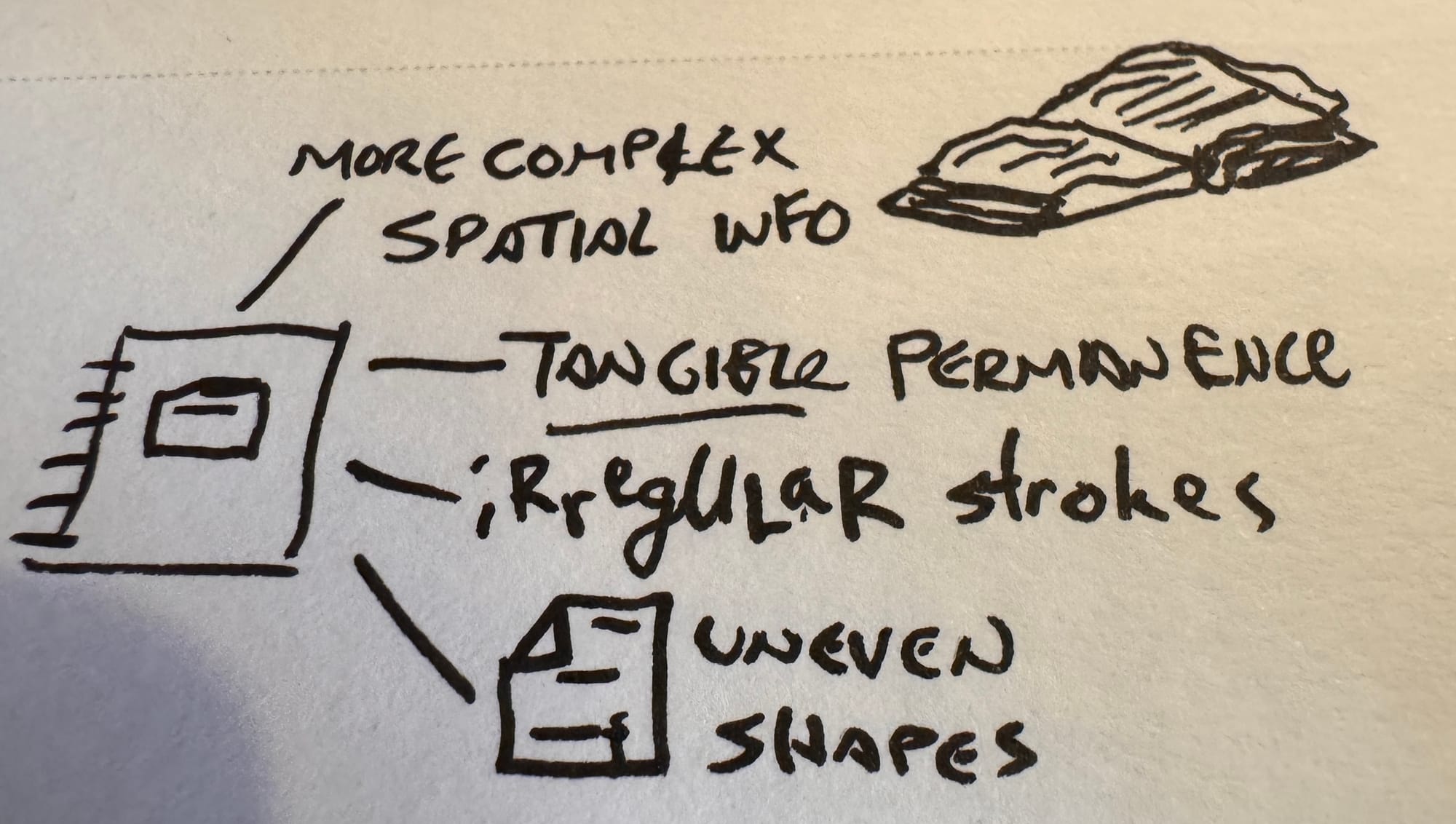
This is a section of my notes while researching this article, for example, which provides pretty much the same information as the one-hundred-sixty-four words before it — and which one do you think is easier to write? Easier to understand?
More engagement = better memory
It’s important to note (ha) that this study was not focused on ADHD. Also, it was (like most studies) mainly consisting of students between the ages of eighteen to twenty-nine.
They had a brief conversation with the researcher, talking about an imaginary schedule including appointments, due dates, and other information. Then they were given a break, along with an “interrupting” activity (that would keep them from thinking solely about the conversation.
Then, simply enough, they were quizzed on the schedule, including attempting to re-create it from memory.
The findings were pretty solid, as can be seen from this totally legit summary of results in my notebook:
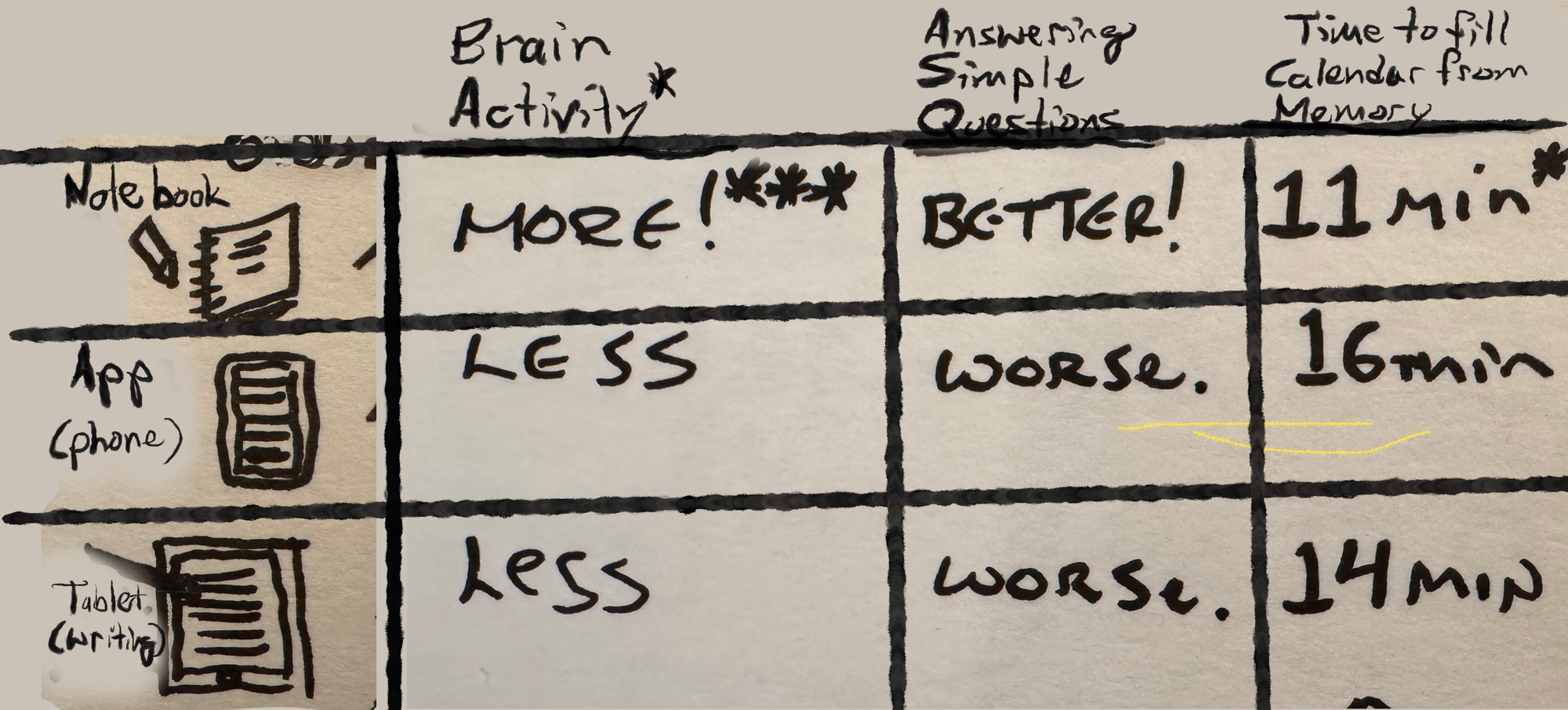
* this was related to memorization and associated encoding of information
** the functional MRI indicated higher activity related to language, imaginary visualization, and also in the hippocampus
*** researchers also suspect that this brain activity would be even higher in younger, less developed brains (get kids notebooks for the holidays!)
And while this did focus (ha) on scheduling, the lead researcher, Dr. Sakai, said in an interview:
It is reasonable that creativity will be more fruitful if prior knowledge is stored with stronger learning…for art, composing music, or other creative works, I would emphasize the use of paper instead of digital methods.
But wait. There’s more. 70% more (well, less).
Even before LLMs made it cool to check your sources, I learned to not trust the results of individual studies. This was from 2021, and wasn’t even about ADHD in particular. And while there is no shortage of both scientific and anecdotal articles advocating physical notebooks over digital, I wanted to find out more about the kind of neuroqueer brains we have. I went on a hunt for more directly relevant data, whether it was corroborating or contra-indicating.
And I found a study from 2024 called The effects of notetaking modality and symptoms of attention-deficit/hyperactivity disorder (ADHD) on learning from a journal called Educational Psychology.
When I read the study, I kind of panicked when I read part of the researchers’ hypothesis: “ …for students with higher ADHD symptoms, we predicted that taking notes with a laptop would lead to higher quiz scores compared to handwritten or tablet notes.”
The last thing I wanted to hear was that it was better to type notes. That would leave me with only four reasons to buy any particular cool notebook I found!
But more importantly, there was a finding that included the control (non-ADHD) group as well:
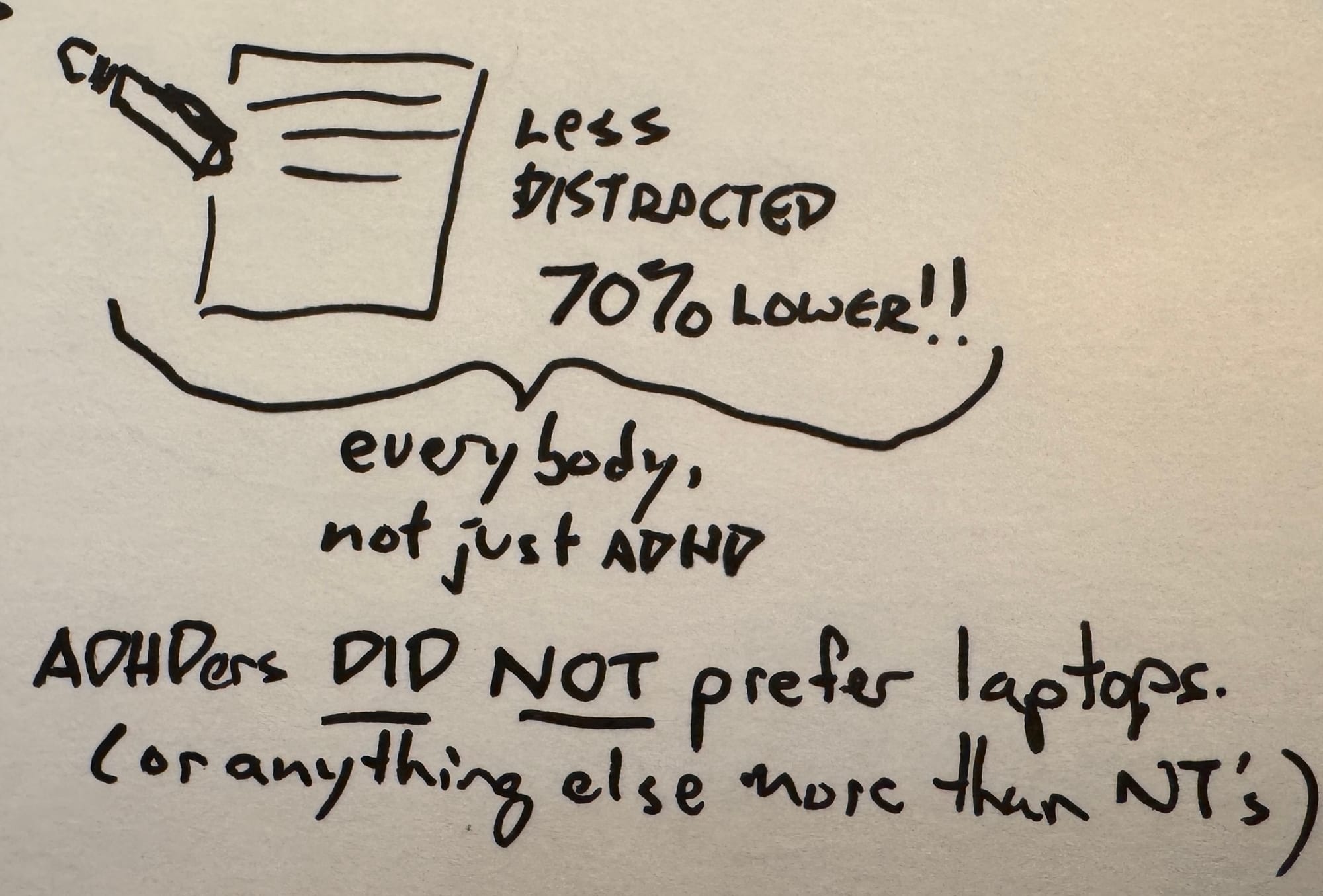
All of the participants who used pen-and-paper notebooks — regardless of their neurotype — had a 70% less chance of being distracted.
Now, somebody’s going to tell me “just pause notifications” or ”set up a focus mode” or something like that. I think they’re missing the point: you don’t have to do that with a notebook. You don’t have to take steps to insulate yourself from the rest of the world. Or charge it. Or find a WiFi connection.
You open it up, you start writing. Either notes about what’s going on around you, or whatever’s going on in your head.
The Bonus Reason to Use a Notebook & Pen
The most common reason people give for not using pen and paper is “it’s not searchable.”
Guess what? It is.
If you take a picture of your notes, and just have them in your Apple notes or photos or Google Drive*, those platforms can read most of your writing. You can literally search and find text, and often, when you find it, you can select it and copy it as text to insert into a regular computer document.
BAM. Objection obliterated.
And finally — it’s not guaranteed, but the fact is we have books and papers from centuries ago that we can still read. The Declaration of Independance, the Magna Carta, the frikkin’ Book of Kells.
On the other hand, I have a bunch of Zip disks with MacroMedia Director files on them from twenty years ago that I couldn’t read without a whole lot of luck and effort. All the notes I kept on my Palm Pilot through college? Gone.
Regardless of whether you are writing for the future or writing for the now, the odds are better that paper and pen will still be usable regardless of the next iteration of insertable Apple iBalls or Samsung Universe*.
And turns out, the odds are better that your brain will understand it better now, as well.
* probably others, too, those are just the ones I know about
** don’t google that, I’m just extrapolating from “Galaxy”
I’m launching a hands-on course called Papermancy in December of 2025. It’s a 4-week online craft-based journaling and reflection system for tactile thinkers and creative minds. You will create a space where sensory play meets structure — with ritual practices that help you externalize thought, focus gently, and find meaning through the physical act of making notebooks and making marks.
You don’t fill these pages; you work with them, like a spell, or a conversation. Sound interesting? Email me at [email protected] and I’ll notify you when we open registration!


Comments ()