How I Accidentally Created My ADHD-aemon
There are times when writing about ADHD executive functions feels like I’m voicing some weird productivity dalek from Dr. Who: “Externalize! Externalize! EXTERNALIZE!!” It’s a hollow complaint, though, because the truth is I *love* finding ways to externalize executive functions.
And how it helps my brain day-to-day
There are times when writing about ADHD executive functions feels like I’m voicing some weird productivity dalek from Dr. Who: “Externalize! Externalize! EXTERNALIZE!!”
It’s a hollow complaint, though, because the truth is I love finding ways to externalize executive functions. It’s an endlessly fertile creative field that appeals to my maker side, my nerdy side, and even my D&D side (if you want to see these come together, visit Papermancy).
But what exactly are those executive functions? Turns out not everyone agrees on what to call them, what they do, or even how many there are. But one of the most-used is the one developed by Dr. Thomas E. Brown, naming them Activation, Focus, Emotion, Effort, Memory, and Action.
I’m not going to defend or extol this model, which many ADHD folks find flawed. It is useful to me as a framework for the pragmatic, tactile methods I try to create to manage my own challenges in my every day life.
But how to remember the Executive Functions and what they represent?
This is not a joke — though it is hilarious: literally as I was writing this article, up there where I list the executive functions? I got to the one after Effort and ran into an obstacle. “What is the next one, it’s an M, um, motivation maybe? No, that’s Effort and Action…Oh.”
If you haven’t already looked above to check, do you remember?
It’s memory.
My brain has a daemonic sense of humor, it seems.
But I do know how to game my memory. My parents, correctly, thought that if I would have a near-photographic memory, it would be a huge advantage in life.
Unfortunately, little did they know that I didn’t have a brain that would respond well to neurotypical memory training — so it was not fun.
But I did learn a lot about memory techniques, including the ones (finally) that did work. Imagery! Not quite the classic “memory palace” idea, but sketchnotes, iconography, and sigils work really well.
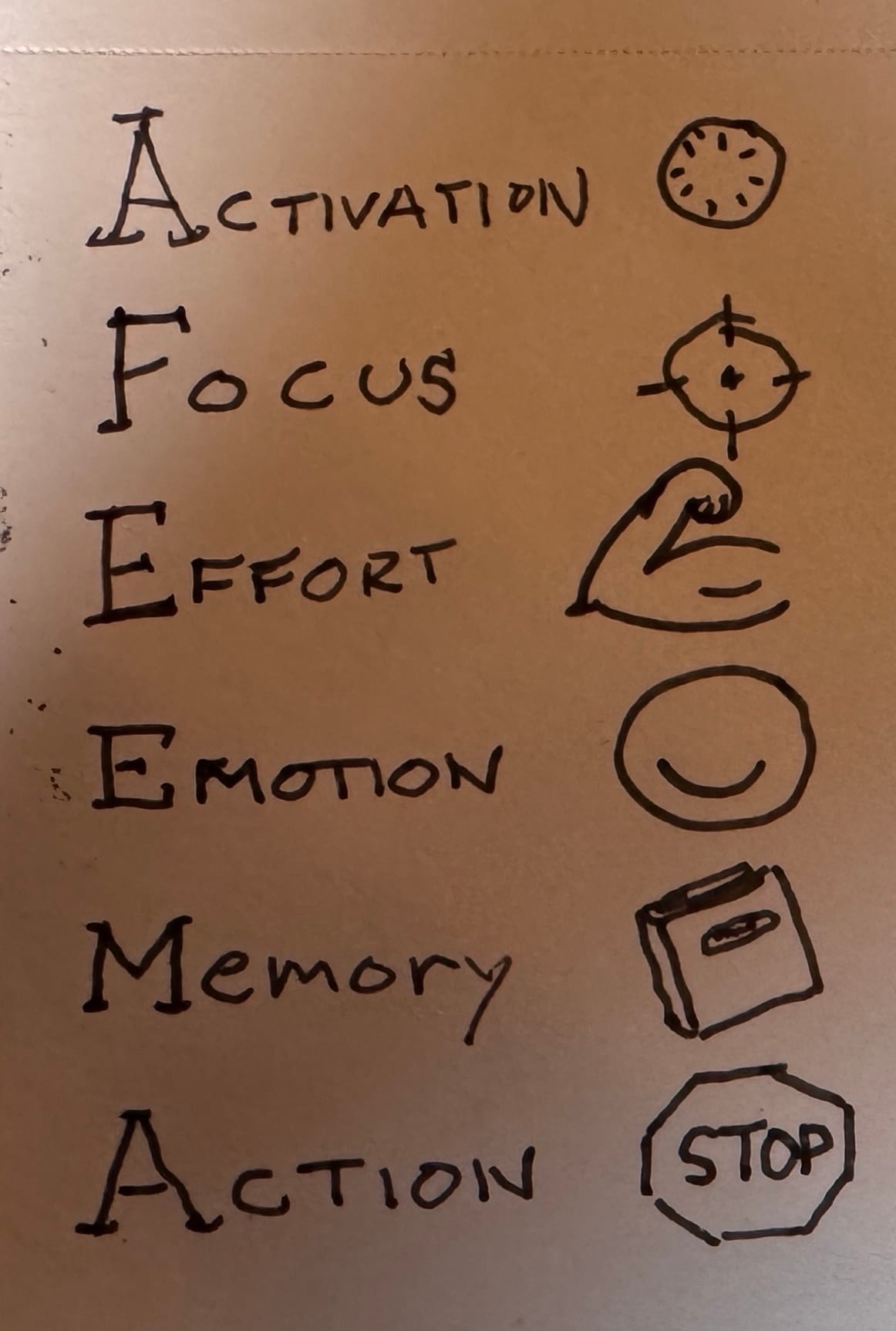
I set out to “imagify” a mnemonic for the executive function that would also help me remember what they do.
- Activation: This is the ability to start things when they should be started, as well as what needs to be prioritized, and how much effort it will take.
I pictured a clock, of course, because that is for my sense of time what my glasses are for my eyes. - Focus: This one needs no explanation, because it’s the first and main thing everybody talks about with ADHD. I pictured the pretty obvious (if unfortunately violent) image of a crosshairs.
- Effort: This is being able to pace yourself, to sustain your energy to get things done. I am a comic book geek; I immediately pictured big muscular He-Man arms.
- Emotion: Emotional regulation has been one of the biggest benefits of getting my ADHD diagnosis and medication. I took the easiest route for a symbol: a smiley emoji.
- Memory: Working memory, as in having the information that is needed when you need it — that’s been the bane of my existence. But if you know me at all, you know the icon I thought of: a notebook, of course.
- Action: Now you might think “wait, wasn’t activation the same thing?” But they’re actually entirely different, though working in tandem with Effort: Activation starts you doing something, Effort gives you the energy you need to do it, and Action serves as the ability to make sure you’re actually doing what is needed. It is what keeps you from cleaning the kitchen when your partner sent you in there to get a paper towel. I thought of it as a crossing guard, of sorts, and so I pictured one of those hand-held stop signs.
For those at home keeping score, here’s the final list:
Putting it all together: introducing AFEEMA
Once I had the elements, I saw, with the horrible clarity of a failed medical student from Ingolstadt, what I had to do next.
The first letters of Dr. Brown’s executive function model even gave me an ungendered but pronounceable name for it: AFEEMA.
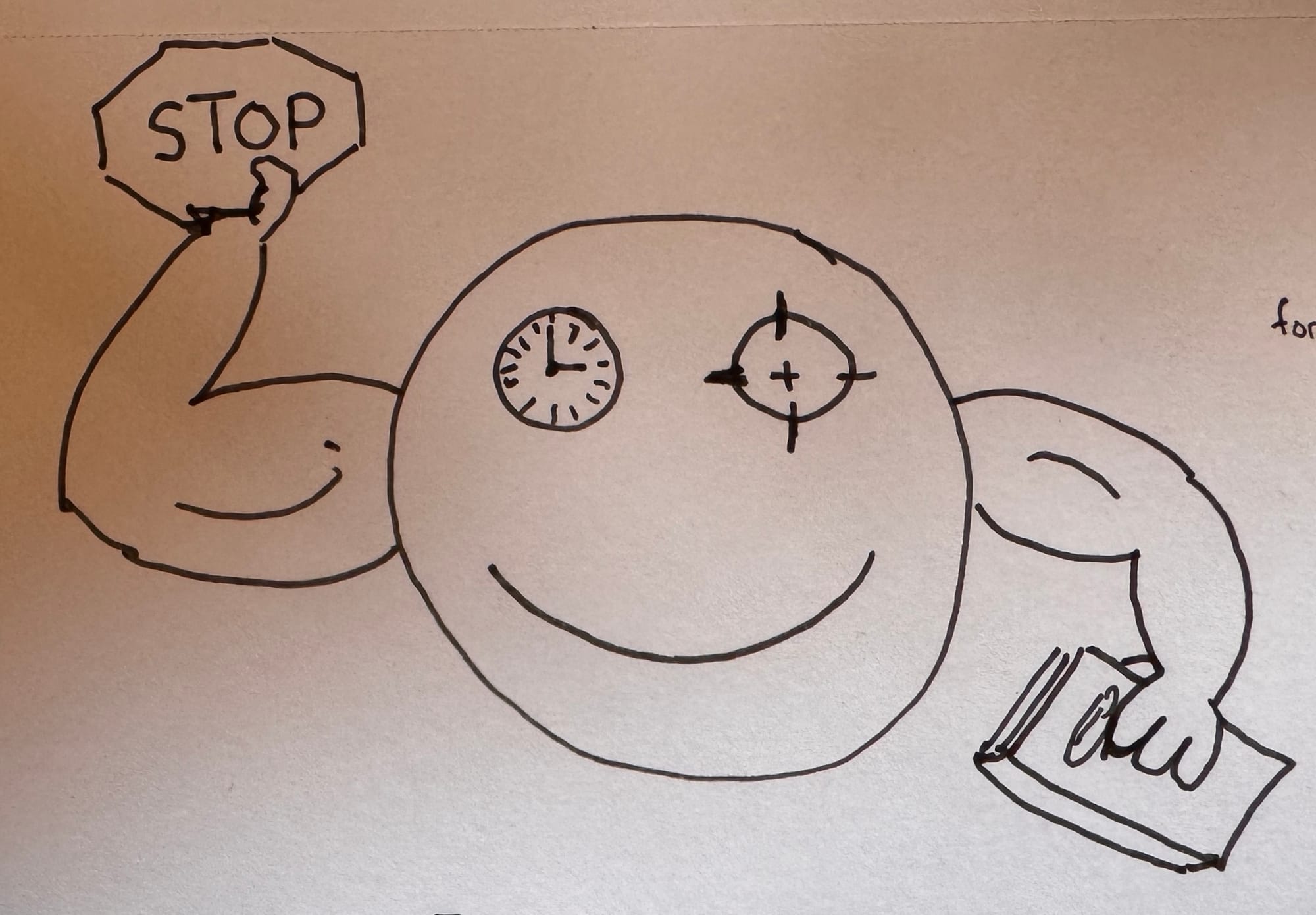
I know. A horrific homunculus slouches towards Bethlehem, its hour come at last (you can tell, because of the clock in his eye).
But you know what? While it is a sort of kludged-together hodgepodge of disparate items that don’t necessarily fit together…
…so is my executive function.
Like it or not, this is the daemon (in the classic and technologic sense of the word) that handles what my brain does for most of the day. In mythology, a daemon was a kind of spiritual connector to the divine, a “ an inner or attendant spirit or inspiring force. according to Merriam-Webster.
And any coders will already be nodding their heads, because for them a daemon for years was “… a background process that handles requests for services such as print spooling and file transfers, and is dormant when not required.”
Yep. That sounds like executive function alright.
And by externalizing this model into a personal concept, it gives me more tools and metaphors to understand what my brain is doing. After a long day of sustained effort at work, maybe I realize those strong arms are tired, and I don’t try to alsouse that evening to install the bathroom fan timer. If I’m losing track of time and appointments, I have the visual metaphor of AFEEMA widening their eyes, both focusing on and sensing time.
I don’t know; I just came up with this a week ago, and it’s been mulling around my brain. I showed it to an occupational therapist I know and she was thrilled, saying that it would help teach kids and adults how executive function worked —which makes me think a stuffy might be needed?
What do you think? Horrific? Helpful? Or both?
Comments ()